
Home›General Urology› Vesicoureteral Reflux
How Vesicoureteral Reflux Treatment in Turkey Is Chosen: Watchful Waiting, Endoscopic Injection or Ureteral Reimplantation
Vesicoureteral reflux (VUR) is the backward flow of urine from the bladder towards the kidneys. It is found in 30 to 40 percent of young children investigated after a urinary tract infection. Many cases resolve as the child grows, so the aim of treatment is not to stop reflux at any cost but to protect the kidneys from infection and scarring while choosing the least invasive option that works. In Turkey, every option, from antibiotic prophylaxis to robotic reimplantation, is offered in paediatric urology practice.
VUR Treatment Options at a Glance
Management of reflux falls into three groups: non-surgical care, a minimally invasive endoscopic injection, and open or robotic surgery. European (EAU/ESPU) and American (AUA) guidelines agree on the options; the choice between them is individual. Urologists in Turkey follow the same EAU/ESPU pathway.
| Treatment | Typically used for | Hospital stay |
|---|---|---|
| Observation | Grade I to II, no recurrent febrile infections | None |
| Continuous antibiotic prophylaxis | Infants, grade III to V, recurrent infections | None |
| Bladder and bowel therapy | Toilet-trained children with voiding problems | None |
| Endoscopic injection | Grade II to IV, breakthrough infections | Day case |
| Open ureteral reimplantation | Grade IV to V, failed injection, anatomical problems | 1 to 3 nights |
| Robotic reimplantation | Older children and adults | 1 night |
What Is Vesicoureteral Reflux?
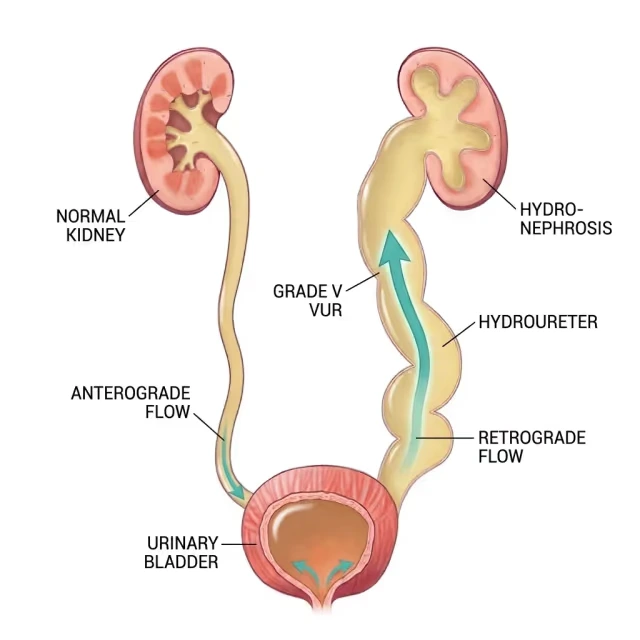
Urine normally flows one way, from the kidneys down the ureters into the bladder. Each ureter enters through a tunnel in the bladder wall that is squeezed shut when the bladder fills, acting as a one-way valve.
In vesicoureteral reflux this tunnel is too short or the ureter opening is in the wrong position, so the valve does not close. Urine is pushed back up the ureter, sometimes as far as the kidney. Sterile reflux is harmless; the problem is that bacteria travel with it, turning a bladder infection into a kidney infection.
Primary and Secondary Reflux
- Primary VUR: a congenital valve defect, by far the most common type and the one that can improve with growth
- Secondary VUR: caused by high bladder pressure, for example from posterior urethral valves in boys or a neurogenic bladder in spina bifida; the cause is treated first
VUR Grades I to V
Reflux is graded on the International Reflux Study scale from the voiding cystourethrogram. The grade is the single strongest predictor of whether reflux will resolve and which treatment will work.
Grade Explorer
Tap a grade to see what it means
Grade IMild
Urine reaches the ureter only. The ureter is not dilated.
Resolves on its own
About 80%
One injection works
About 70 to 80%
Usually considered
Observation; prophylaxis mainly for infants or repeated infections
Grade IIMild
Urine reaches the kidney, with no dilatation of the ureter or kidney.
Resolves on its own
About 80%
One injection works
About 70 to 80%
Usually considered
Observation; injection if febrile infections break through
Grade IIIModerate
Mild to moderate dilatation of the ureter and kidney.
Resolves on its own
About 50%
One injection works
About 70 to 80%
Usually considered
Antibiotic prophylaxis; endoscopic injection if infections continue
Grade IVSevere
Moderate dilatation, with blunted calyces in the kidney.
Resolves on its own
About 10 to 30%
One injection works
About 50 to 60%
Usually considered
Prophylaxis, then endoscopic injection or reimplantation
Grade VVery severe
Gross dilatation, with a tortuous, twisted ureter.
Resolves on its own
Rarely
One injection works
About 50 to 60%
Usually considered
Ureteral reimplantation is preferred
Simplified diagram. Resolution rates are approximate, over about five years, and are lower with reflux on both sides, an older age at diagnosis or bladder and bowel problems.
| Grade | What the X-ray shows | Resolves without treatment |
|---|---|---|
| I | Urine reaches the ureter only | About 80 percent |
| II | Reaches the kidney, no dilatation | About 80 percent |
| III | Mild to moderate dilatation of ureter and kidney | About 50 percent |
| IV | Moderate dilatation, blunted calyces | About 10 to 30 percent |
| V | Gross dilatation, tortuous ureter | Rarely |
Figures are approximate five-year rates, lower with bilateral reflux, an older age at diagnosis or bladder and bowel dysfunction.
Causes and Who Is at Risk
- About 1 percent of all children have VUR
- 30 to 40 percent of infants and toddlers with a urinary tract infection have it
- Girls are diagnosed about twice as often, but boys are usually diagnosed younger and with higher grades
- Around a quarter to a third of siblings of an affected child have reflux, and more of the children of affected parents
- Prenatal hydronephrosis (a swollen kidney on pregnancy ultrasound) is a common first clue
Symptoms
Reflux causes no symptoms by itself. It is found through the infections it causes or on a scan done for another reason.
- Fever without an obvious cause, especially in infants
- Irritability, poor feeding or vomiting in babies
- Pain or burning on passing urine
- Frequent, urgent urination or new daytime wetting
- Foul-smelling or cloudy urine
- Flank or abdominal pain in older children
Any fever in a baby with known reflux should be treated as a possible kidney infection and checked with a urine test the same day.
Diagnosis
- Kidney and bladder ultrasound: the first test after a febrile infection, though it can look normal in mild reflux.
- Voiding cystourethrogram (VCUG): the reference X-ray test that confirms reflux and assigns its grade.
- Contrast-enhanced voiding urosonography (ceVUS): a radiation-free ultrasound alternative to VCUG.
- DMSA kidney scan: shows existing scars and how much each kidney contributes to total function.
- Bladder and bowel assessment: voiding diary, urine flow test and constipation history in toilet-trained children.
How Treatment Is Chosen
No single treatment suits every child. The plan is built around the risk of kidney scarring, which depends on:
- Grade, and whether one or both sides are affected
- Age, and whether the child is toilet trained
- Number of febrile infections so far
- Existing scarring on the DMSA scan
- Bladder and bowel dysfunction
- Family preference between long-term medication and a procedure
Low-risk children are observed. Higher-risk children receive prophylaxis first, and a procedure is offered when infections break through, new scars appear or high-grade reflux persists.
Observation and Antibiotic Prophylaxis
Observation means no daily medication, a urine test whenever the child has a fever, and repeat imaging every 12 to 24 months.
Continuous antibiotic prophylaxis is one small evening dose, usually trimethoprim-sulfamethoxazole or nitrofurantoin, or amoxicillin in the first months of life. The RIVUR trial, the largest randomised study in reflux, found it cut repeat infections by about half but did not reduce new kidney scarring and increased antibiotic resistance. Most specialists therefore reserve it for infants, grades III to V and repeated febrile infections.
Bladder and Bowel Dysfunction
Holding urine, infrequent voiding and constipation raise bladder pressure and keep reflux going. In toilet-trained children, treating them is often the most effective step and improves every other treatment.
- Timed voiding every two to three hours
- Relaxed posture on the toilet, with feet supported
- Plenty of water through the day
- Treating constipation with diet and laxatives
- Pelvic floor biofeedback where needed
Endoscopic Injection (Deflux)
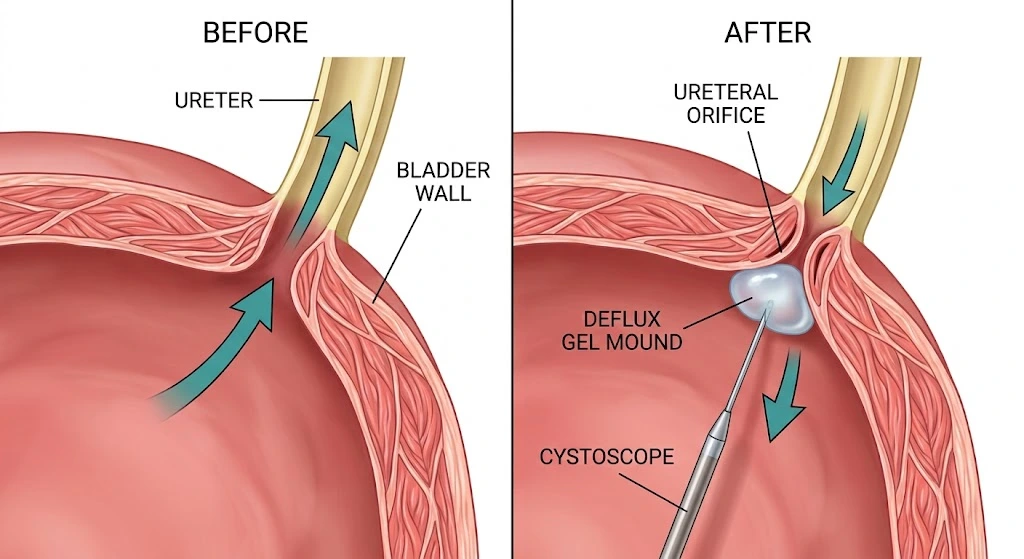
Under a short general anaesthetic, a thin camera is passed into the bladder through the urethra. A gel, most often dextranomer hyaluronic acid (Deflux), is injected just under the ureter opening. The gel forms a mound that supports the valve so it closes when the bladder fills.
- No incision; takes 15 to 30 minutes
- Most children go home the same day
- Normal activity within one or two days
- Grades I to III: about 70 to 80 percent success with one injection
- Grades IV and V: about 50 to 60 percent success with one injection
- About 85 percent after a second injection
- Ultrasound, often with a cystogram, confirms the result at three months
Ureteral Reimplantation
Reimplantation rebuilds the valve by creating a longer tunnel for the ureter inside the bladder wall. It is the most effective treatment, correcting reflux in about 95 to 98 percent of children.
Open Surgery
- A small, low incision above the pubic bone, usually hidden below the underwear line
- Intravesical techniques (Cohen, Politano-Leadbetter) work from inside the bladder; extravesical (Lich-Gregoir) from outside
- One to three nights in hospital
- Preferred for grade V, very dilated ureters, failed injection and duplex systems
Robotic Reimplantation
- Extravesical reimplantation through three small keyhole incisions
- Less pain, a shorter stay and a quicker return to school
- Success approaching open surgery in experienced hands, around 90 to 95 percent
- Relies on the same robotic surgical skills used in robotic kidney surgery and robotic adrenalectomy
- Best suited to older children, adolescents and adults
- Available at a growing number of hospitals in Turkey
Comparing the Options
| Prophylaxis | Endoscopic injection | Reimplantation | |
|---|---|---|---|
| Corrects reflux | No, waits for resolution | 70 to 85 percent | 95 to 98 percent |
| Anaesthetic | None | Short, general | General |
| Hospital stay | None | Day case | 1 to 3 nights |
| Main drawback | Daily doses, resistance | May need repeating | Most invasive option |
VUR Treatment Prices in Turkey
The same procedures cost several times more for families paying privately in the United States, the United Kingdom, Europe, the UAE or Saudi Arabia. Turkey offers the same guideline based treatment at a fraction of the price.
| Treatment | Turkey Best value | United States | United Kingdom | Europe | UAE |
|---|---|---|---|---|---|
| Endoscopic Deflux injection | $3,000 to $6,000 | $10,000 to $25,000 | £3,500 to £6,000 | €4,500 to €8,000 | $5,000 to $10,000 |
| Open ureteral reimplantation | $5,000 to $16,000 | $25,000 to $50,000 | £9,000 to £15,000 | €13,000 to €19,000 | $8,000 to $18,000 |
| Laparoscopic ureteral reimplantation | $6,000 to $18,000 | $30,000 to $55,000 | £10,500 to £16,500 | €14,000 to €21,000 | $10,000 to $22,000 |
| Robotic ureteral reimplantation | $7,500 to $22,000 | $35,000 to $65,000 | £12,000 to £19,500 | €15,500 to €24,000 | $15,000 to $30,000 |
Every figure in the Turkey column is a typical package price and usually includes surgery, anaesthesia, hospital stay and tests. Prices for other countries are typical private, self pay ranges. Your exact price in Turkey depends on the reflux grade, whether one or both sides are treated, and the length of stay. A personal quote is given after reviewing your scans.
Recovery and Follow-Up
- After injection: mild burning on passing urine for a day or two
- After open surgery: bladder spasms and blood in the urine for a few days; back to school in one to two weeks
- Prophylaxis is usually continued until the result is confirmed
- Ultrasound at three months, then at intervals
- Blood pressure and urine protein checks for children with kidney scarring, continuing into adulthood
- Families can send scan reports and follow-up results for review through the contact page
VUR in Adults
Reflux is sometimes first found in adults, usually while investigating recurrent kidney infections, high blood pressure or protein in the urine. Women with a history of reflux or kidney scarring should tell their obstetrician, as pregnancy raises the risk of kidney infection. In adults with symptomatic reflux, robotic reimplantation or endoscopic injection are the usual options. Adults with reflux can arrange an assessment through the contact page.